AI is already writing your record.
Someone still has to sign it.
Blueprint Integrity Group validates what your AI documented, coded, and assumed before a payer, an external auditor, or the OIG does it for you.
Confidence is not competence
Ambient scribes, computer-assisted coding, autonomous coding engines, risk-adjustment capture tools… they are already in the chart. They are fast, they are fluent, and they are almost never wrong in a way that looks wrong.
That’s the problem.
A human coder who is uncertain leaves a gap, a query, a question mark. A machine that is uncertain writes a complete sentence. It produces documentation that reads as if witnessed, structured as if clinically reasoned, and coded as if verified, because fluency and accuracy are two different things, and only one of them is viable on the page.
Your providers are not reviewing AI output with the skepticism they’d bring to a resident’s note. They’re reviewing it the way we all review something that looks finished.

What AI does genuinely well
Capture volume no human could keep up with
Surfaces documentation gaps in real time
Applies rules consistently, every single time
Never gets tired at 4 PM on a Friday
What it quietly breaks
Fluency without evidence- Writes what usually happens, not what happened.
Inference presented as observation- An assumption, formatted as a finding.
Specificity it wasn’t given- Narrows a code that the record doesn’t support
Consistency without correctness- A wrong rule applied perfectly, ten thousand times
The signature is still yours
When a payer requests the record, they don’t ask which vendor generated the note.
The attestation is the provider’s. The claim is the practice’s. The overpayment is the practice.
The model is not a party to the transaction and never will be.
No vendor’s accuracy claim has ever appeared as a defense in a repayment demand, and vendor accuracy is measured against the vendor’s own gold standard, not against the payer’s.
When
The AI-generated it is not the mitigating factor. It’s an internal controls finding.
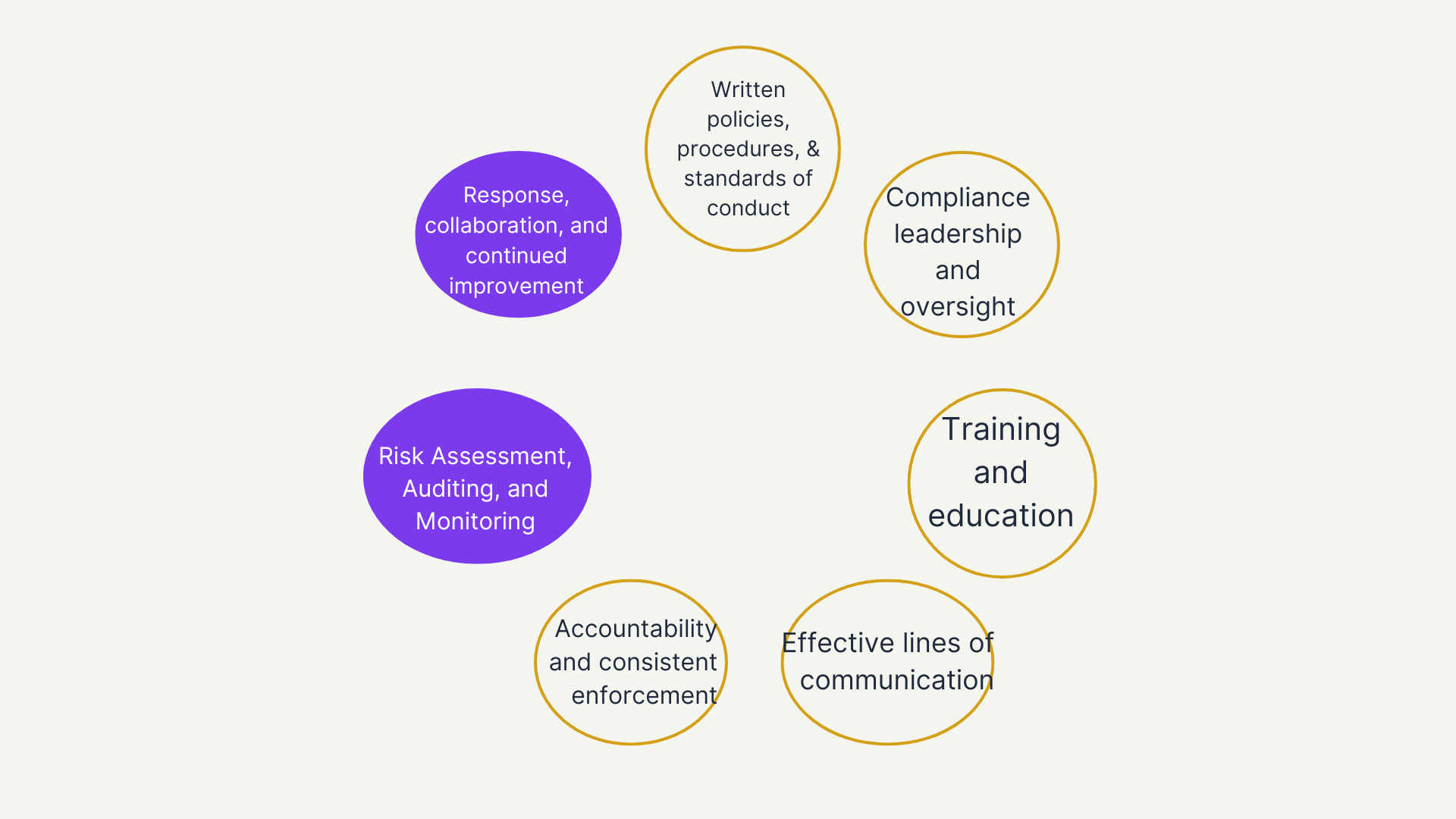
An effective healthcare compliance program depends on seven connected elements:
AI doesn’t replace your compliance program. It stress-tests it.
Every element matters. But a compliance program cannot protect an organization from risks it has not identified, and most programs were built before anything in the record was machine-generated.
Ask honestly: Does your policy manual address AI-Assisted documentation at all? Has anyone been trained on what to distrust? Who is accountable when the model is wrong: the provider, the coder, the vendor, or nobody? And is anyone auditing the AI’s output, or only the humans’?
If the honest answer to that last one is “nobody’s auditing the AI,” you have a monitoring gap that grows every single day the tool runs.
Where B.I.G. Fits
We work where risk becomes visible: Risk Assessment, Auditing, Monitoring, Reporting, and Collaborative Improvement
AI Validation Review: We sample AI-generated documentation and AI-suggested codes against the underlying record and the Official Guidelines. Not vendor metrics. Source documents.
Interface mapping: We identify where the tool infers rather than reports, and quantify how often.
Policy Education: We train clinicians on what to trust, what to verify, and what to delete without turning them into full-time editors.
Findings are not the end of the process. They are an opportunity for collaboration.